Welcome
The Story of Orion
History
How It Worked
Legality
Fallout
Future
People
Freeman Dyson
George Dyson
Stanislaw Ulam
Ted Taylor
Books
Project Orion
Fiction
Videos
Factual
Fiction
Orion Drive > The Story of Orion > How It Worked
|
The basic idea for Project Orion is quite simple: can we use the blast from a nuclear bomb to generate thrust for a spacecraft?
The first idea that was considered, "Helios", was conceived by Freeman Dyson, who suggested exploding a small (0.1 kiloton) atomic bomb inside a combustion chamber approximately 40 meters (130 feet) in diameter. Water would be injected into the combustion chamber, superheated by the atomic blast, and then used for propulsion. The process would then be repeated, with each "pulse" from a subsequent atomic explosion adding to the vehicle's velocity. This idea was however problematic in that developing a combustion chamber that wasn't destroyed by the explosion would be a tremendous challenge. Furthermore the performance of Helios was relatively poor, only about 2½ times the specific impulse (that is the change in momentum per unit of propellant) of today's best chemical rockets.
The break-through can when Stanislaw Ulam realized that the nuclear explosion could only not be realistically contained, but that it did not need to be contained. Instead, nuclear bombs and reaction mass could simply be dropped out the back of the vehicle and exploded at some distance away, perhaps 60 meters (200 feet). The blast would generate a plasma wave which would impact a thick steel or aluminium pusher plate at the rear of the vehicle, causing the vehicle to move forward. Furthermore, it was possible to design the propellant units in such a way so that most of the energy from the bombs would be directed towards the pusher plate rather than in other directions.
Of course, the nuclear explosions would generate sudden shocks of massive acceleration (less than a millisecond duration) - this has been described as being hit by an atomic-powered sledgehammer. For a properly designed unmanned vehicle, these sudden accelerations are not necessarily a problem, but for a crewed vehicle, the acceleration needs to be smoothed out to a level that the crew could bear (1g to 3g) - and this would have done been using massive (multi-story high) pneumatic spring shock absorbers.
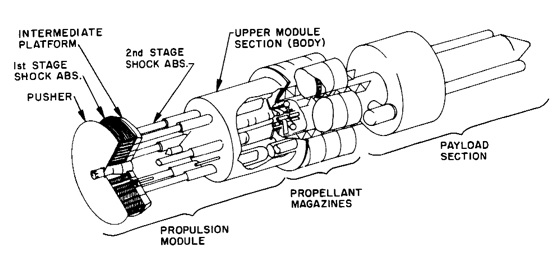
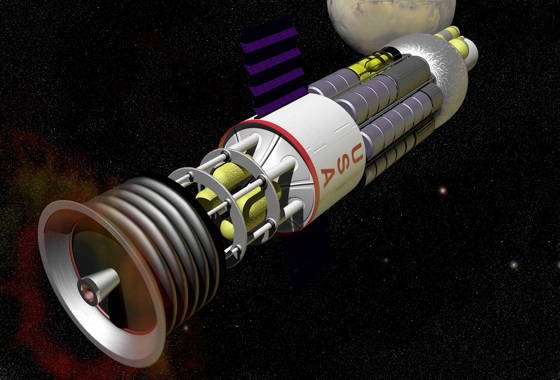
The other consideration is that of the survivability of the pusher plate, which is of course directly exposed to the plasma wave generated by the atomic blast. Many people would assume that any object close to a nuclear explosion could not survive - however this assumption turns out to be incorrect. Even though the plasma wave is tremendously hot, easily hot enough to vaporize steel or aluminium, the time of contact with the pusher plate is so brief that the metal can survive (the same principle is used in automobile engines) - indeed in the case of Orion, it turns out that a cooling system is not even necessary. Additionally, it was believed (due a chance discovery made during the atom bomb tests of the 1950s) that spraying the pusher plate with a few millimeters of graphite-based oil before each explosion would eliminate all ablation of the pusher plate.
- Here is a computer animation of what a Project Orion spacecraft would have
looked like in flight:
|
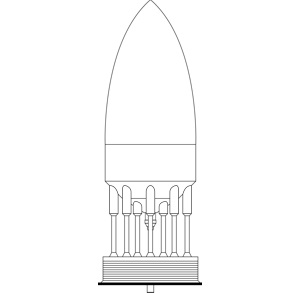
The following chart shows figures for 3 different Orion designs:
| Satellite | Midrange | Super | |
| Ship Diameter | 20 meters | 40 meters | 400 meters |
| Ship Mass | 300 t | 2,000 t | 8,000,000 t |
| No. of Bombs | 540 | 1,080 | 1,080 |
| Mass per Bomb | 0.22 t | 0.75 t | 3.00 t |
| Bombs % of Total Mass | 40% | 40% | 4% |
| Ship % of Total Mass | 60% | 60% | 96% |
In the final period of research on Project Orion, an alternative to ground-based launch was considered: assembling a very small Orion vehicle in Earth orbit, using 2 or 3 Saturn V launches. Although less efficient, by far, than the ground launched variants, this design would have completed avoided the issue of fallout. Despite its limitations, the vehicle would have been capable of taking 8 people to Mars and back in a voyage that would have lasted about a year.
Project Orion was of course never built, despite all the tests and research indicating that it was not only possible, but also feasible and affordable too. However a 1 meter (3 feet) model weighing 105 kilograms (231 pounds) was built, and successfully demonstrated.
- Here is a video showing the Orion test model in
action:
